Damp Proof Coating for Walls: When It Helps, When It Fails
August 13, 2026
Insulating a damp wall from inside: treat the masonry before you line it
September 28, 2026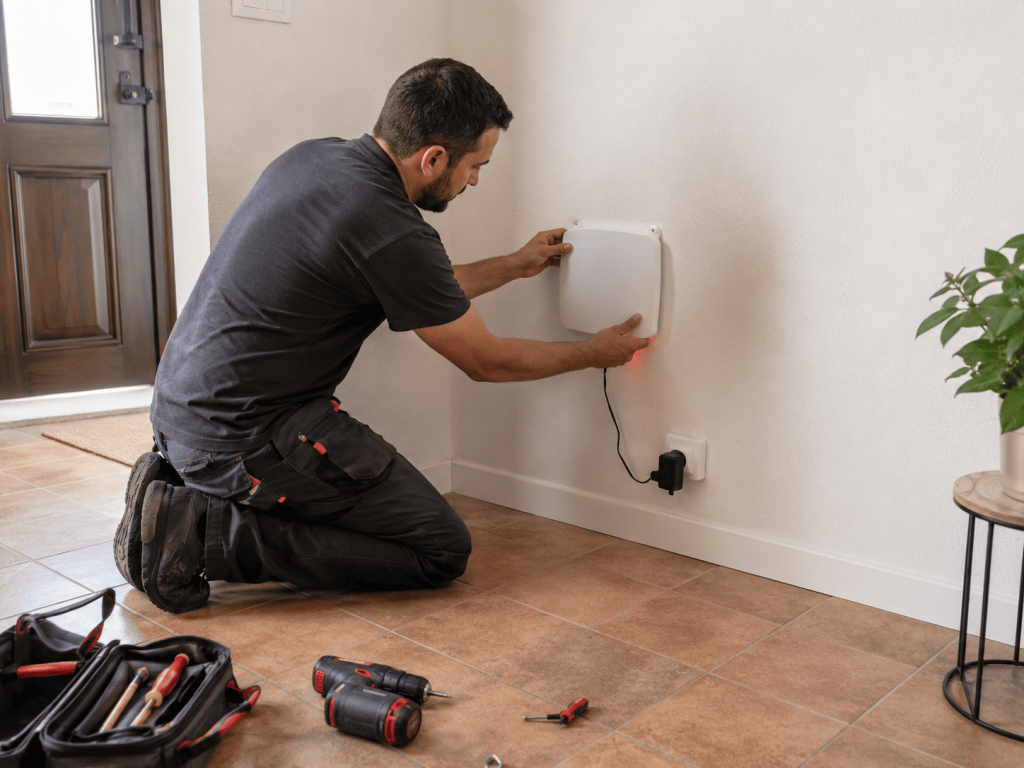
Working out how to keep customers coming back means staying the name they think of for their next job, long after the invoice is paid. The strongest lever is a real reason to return: a check-up, a finish, advice you followed through on. Treating rising damp builds exactly that link. A wall generally dries out over 18 to 24 months, and that timeline gives you several legitimate visits with the same customer.
Why a happy customer doesn’t always call you back
Plenty of tradespeople don’t lose customers over bad work. They lose them to the silence that follows the job. Three things work against you.
The job closes the relationship
Once the invoice is paid, nothing ties you to the customer any more. Two years later, for the bathroom or the render, they look for a tradesperson as if they’d never met you.
The problem resurfaces under your finish
Blistering paint or crumbling render at the base of a wall, and it’s your work that gets judged, even when the water’s coming up from the ground. A disappointed customer doesn’t come back, and tells people about it.
You only see part of the house
Called out for one room, you miss the other issues. A stained wall base in the hallway can still open a conversation that leads to a job, and then to a follow-up.
How to keep customers coming back with the drying timeline
Treating rising damp means fitting a polarity inverter on the damp load-bearing wall, then following the wall through as it dries. That timescale, often presented as a downside, becomes your best loyalty tool. Here’s how to structure it.
Step 1: fit the device and mark the starting point
On installation day, mark the top of the damp area in pencil and write the date next to it. Photograph the wall in front of the customer. That mark becomes shared proof of how things are moving.
Step 2: schedule check-up visits
Offer regular slots, every six months for instance: read the mark, take a new photo, check the device is still plugged into a permanently live socket. A short visit that reassures the customer and keeps the link alive.
Step 3: explain the salts before they show up
White deposits can appear during drying: that’s salts the wall is pushing out to the surface. Flagged in advance, it reassures the customer — a sign the wall is moving on. Found with no explanation, it makes them think the treatment has failed.
Step 4: schedule the finish at the right time
The base of the wall stays bare for several months before it’s closed up. Making good the render, breathable paint or fitting new skirting become a second job, planned from the start and carried out by you or a trusted colleague you recommend. An insulation installer gets a second visit out of this too: insulating a damp wall from inside, step by step.
Step 5: review the outcome
At the end of the follow-up, compare the photos against the mark. That’s the moment to talk about other walls, other rooms, and the customer’s contacts who mention the same staining.
Stating the limits upfront to earn trust
A customer stays loyal to the tradesperson who never oversold them. On damp, three points need to be clear before anyone signs anything:
- the device treats rising damp, and only that: infiltration, flooding and surface mould call for other fixes, around waterproofing or ventilation;
- the difference is generally visible after 18 to 24 months, a timescale that varies with wall thickness and how wet it started out;
- installation follows precise rules: a load-bearing wall, the device low down and in direct contact with the masonry, never in a corner.
If you spot infiltration during a visit, say so, even if it’s not your trade. The customer will remember you saved them an unnecessary cost. For unclear cases, this article helps with telling infiltration, a leak and rising damp apart.
Materials that keep your name in the house
Between visits, it’s your paperwork that speaks for you. The customer digs it out the day a neighbour asks who dealt with their walls.
- The device’s explanatory sheet, supplied by Help Humidité Pro, which sets out the principle in plain terms;
- The installation guide, available on the product page, which shows the fit followed a method;
- The 10-year manufacturer’s warranty, handed over with the invoice;
- A photo record of each visit, dated, showing the mark’s position;
- Your card, with the date of the next visit noted on the back.
Word of mouth tends to follow this same path. A wall drying out in an older house becomes something neighbours and family talk about, and nearby houses sometimes show the same symptoms.
Stocking up with Help Humidité Pro without tying up cash in stock
To offer this kind of follow-up, you need the equipment at the right price, at the right time. Help Humidité Pro, the Humidistop subsidiary built for professionals, covers both needs:
- quick sign-up: business name, company registration number, contact details, and the account is active straight away;
- trade pricing that scales with quantity, single-unit orders available;
- free delivery within 7 working days, paid by bank transfer or PayPal;
- materials for your customers: illustrations, explanatory sheets, text you can reuse on your own website;
- no franchise to sign, no minimum term, no territorial exclusivity.
On models, it all comes down to the distance to cover: 15 metres of coverage for the ATE LC15, 30 metres for the ATE LC30 and the ATE Pulse, 60 metres for the ATE MAX. With no permanently usable earthed socket, the ATG steps in instead. Made in Castres, in Occitanie, with partner SYSELEC, under ISO 9001 certification. Before your first job, read through the installation guide.
Frequently asked questions
How do you keep customers coming back without being pushy?
Give every contact a useful reason: checking the mark, a photo, a finish to plan in. A visit that brings the customer information is nothing like a sales chase.
Should you charge for check-up visits?
That’s your call. You can fold them into the price of the install or bill them separately. What matters is the customer knowing, from the quote stage, how many visits are planned.
What do you tell a customer who thinks their wall looks whiter than before?
That it’s normal during drying: salts are moving up to the surface. Show them the pencil mark and the starting photo so they can compare.
Does the device need any maintenance?
No. The ATE runs day and night, silently, with no maintenance at all, using around 0.75 W. The ATG is fully passive: no electricity, no batteries.
Can you order just one device to try it out?
Yes, the Help Humidité trade shop has no minimum order.
In summary
Working out how to keep customers coming back when you’re a tradesperson takes a real reason to return. Treating rising damp gives you several: a starting mark, check-up visits, a scheduled finish and a review. State the limits and the 18-to-24-month timescale, leave clear paperwork behind, and you’ll be the one the customer calls for their next job.